Return of the Cultural Probes | Week 3

A week prior we had disseminated five sets for a cultural probe amongst patients. We now collected them and had the opportunity to sit down with some of the participants and discuss their experiences. Collected here are the responses to and our findings from the probe.

Postcard
We asked the participents to answer three questions in regards to a postcard of four Images of art pieces.

What do you think about works like this?
RED: “Fun, fantasy, nature+art inspiring for own creativity”
YELLOW: “To a part they are great communal works, they stand out or produce a smile. The white ‘h’ though, I find totally out of place, unfitting and not inspiring.”, “h=häää?!”
WHITE: “I find them very beautiful and enriching the environment. A pleasure for the eye.”
BLUE: “One makes nature one’s stage, one’s canvas. –but non-violently. It’s like a compliment of the artist. One gives the tree a dress, one ‘completes’ the old place or fills a corner again.”
GREEN: (To picture one:) “Super expressive, creative, colourful creation.”
(To picture two:) “A cold and closed work.” (To picture three:) “Pure nature.” (To picture four:) “Super interesting… full of meanings…”

What inspires you in these works?
RED: “The colours.”
YELLOW: “Joy and ease in the everyday. (As long as the works aren’t paid for by the taxpayers 🙂 ) In between it’s nice to escape normality, not everything has to have a practical sense.”
WHITE: “The picture with the tree reminds of the project I wanted to do in *Benlav* once. It inspires me to knit again. And the corner of the house with LEGO reminds me of artistic area in Vilnius, Lithuania. It inspires me to dress myself more colourful and bravely and with confidence stand out of the crowd.”
BLUE: “It’s like a game. One plays with nature and adds human silliness.”
GREEN : (To picture one:) “Mediates joy, travelling in the imaginary…”
(To picture two:) “Prison of a river, the stride of the future/goal”
(To picture three:) “What counts is today = get it (in Portugal)”
(To picture four:) “As much as life beats you down, you can always build it up stronger and more colourful.”

From where do you know these works?
RED: “The ‘h’ from the newspaper.”
YELLOW: “The ‘h’ from the town pond, about the trees I once read something in the newspaper, the wall reminds me of the LEGO houses of our childhood, don’t know where it stands. I have never seen the water feature, but I’m sure it’s in the garden of a expensive villa.”
WHITE: “I have only seen similar objects to the first picture – with the knitted around tree. Rest of the objects I have not seen before.”
BLUE: “Half of them don’t remind me of anything. The corner with LEGOs I saw on the internet and the ‘h’ recently by the ‘pond’.”
GREEN: (To picture one:) “No.” (To picture two:) “No.” (To picture three:) “***…Pond”
(To picture four:) “I know (it), but…”

NOTE: The answers of participants RED, YELLOW, BLUE and GREEN have been translated from standard German. We tried to find a balance between getting their answers across concisely, fittingly, in an understandable manner without interpreting too much of our view into them.

FIMO
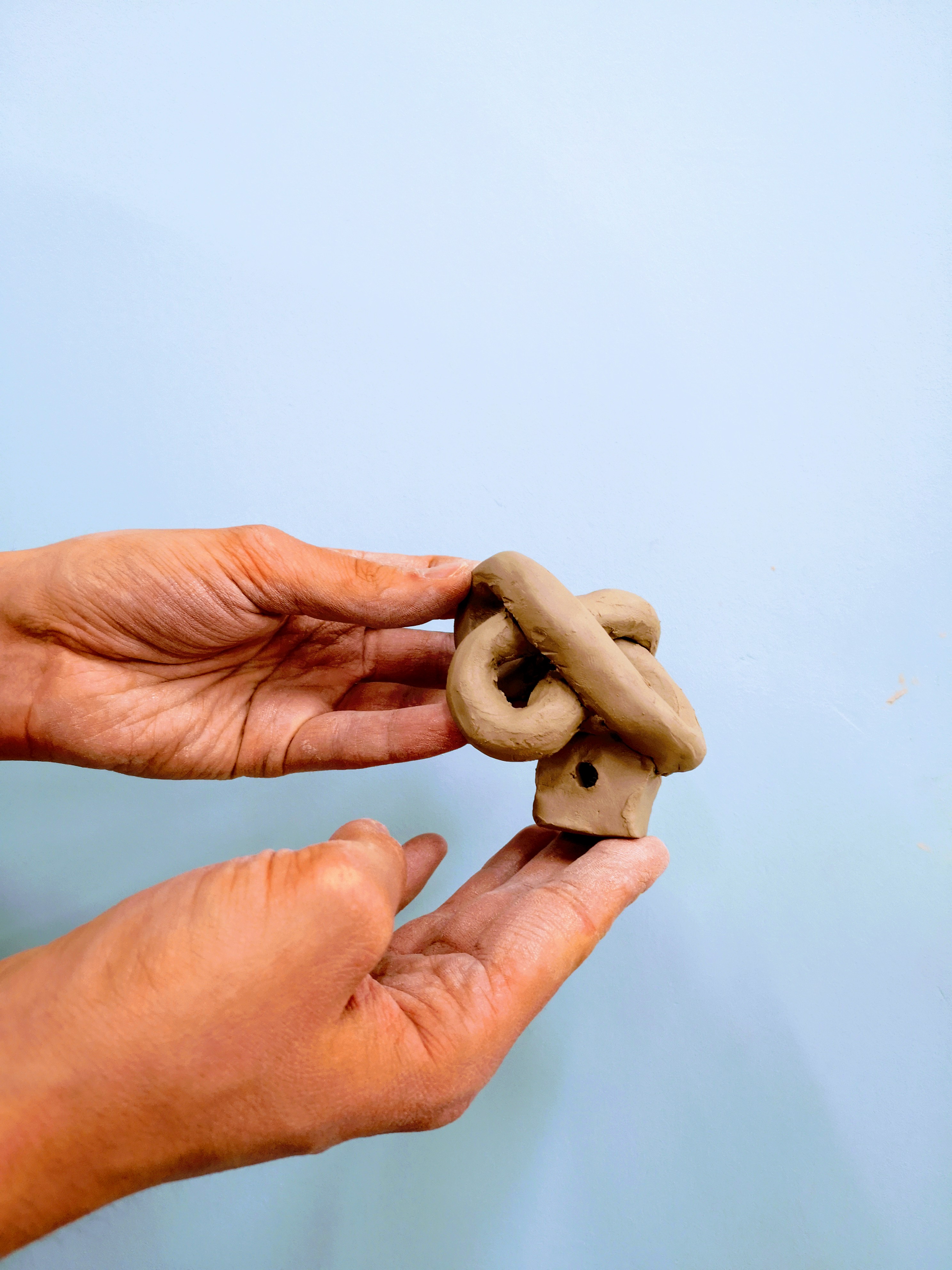
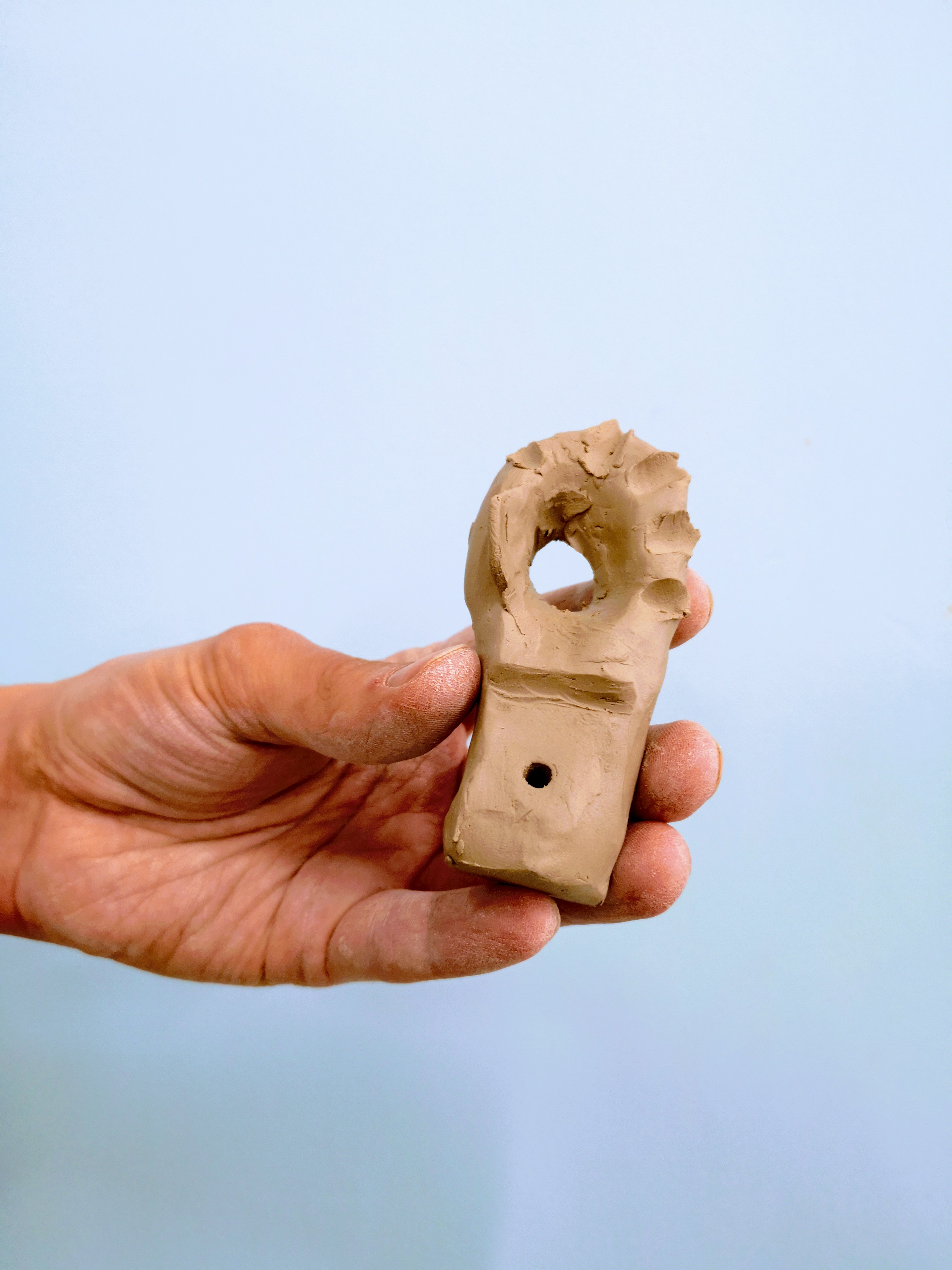
We asked the participants to create a sculpture out of FIMO clay at home.

Stone/Chicken/Egg
We asked them to place three provided objects outside the clinic and to send us photos of them in their new environment:

Map
Finally we asked them to draw their way from the studio to their home and to mark places they especially like.

Findings
In general the answers we received proved to be insightful in many ways we hadn’t expected. We were very excited to see that almost all participants completed all the tasks we asked of them and were also able to use the probes as an introduction to our following workshop. Though the probes may have originally been received with a certain amount of suspicion, the answers we received ended up being very open, and it seemed people enjoyed taking part. One participant mentioned that once they decided to approach the tasks openly they found themselves finding meaning in them, looking at the environment in a slightly different way than normal while looking for a place to take photos. Some of course still were slightly confused about our aim, but discussing the probes afterwards we could explain our intent and this seemed to clarify these cases and lead to a renewed interest in the project.

The responses to the postcard showed a definite interest in the guerilla art projects, especially towards the colourfulness and the integration into the surroundings.
One participant mentioned in the following discussion that she generally prefers combining art with a practical aspect, which could be interesting moving forwards.

The FIMO clay was generally well received, though some felt it hard to knead at first and in one case it had hardened. The participant in this case added oil to the clay, and though it ended up a sticky mess, according to the participant, the textures that resulted from this seemed quite interesting.

Notably, all the participants created sculptures based on plants or animals when left to their own devices. This topic of nature also seemed to continue in the other tasks.
From the feedback we received, placing the objects into the environment appeared to be a generally positive task. Often finding a fitting place happened spontaneously. Again scenes of nature prevail, though some showed interest in exploring more urban environments during our discussions.

The maps show a variety of ways to see one’s path home, some focused on geographical landmarks, impressions along the way, or technical details. In and of themselves, interpreting the responses is still tricky, but they opened a discussion of how the participants see their transit and their surroundings. One mentioned that due to this exercise they found new interesting places along their route.

Generally the discussions we were able to have after the probes had been completed proved to be a vital part. There were some problems regarding our system of uploading photos, this proved too complicated, for only three of five the upload worked, and showing the process to one, on a different mobile OS than we had tested it on, it proved to be excessively obtuse.

Workshop | Week 3

Today we had our prototyping workshop with the patients of the ceramic atelier. We had planned to have it outdoors, to see if and how working outdoors might change the working atmosphere of the participants, however this was not possible due to the cold weather conditions. We therefore decided upon arrival to set up our work space on a separate table inside the ceramics-atelier.

Fortunately we were able to motivate the same people to take part in the workshop, as those who had already helped with the cultural probes.

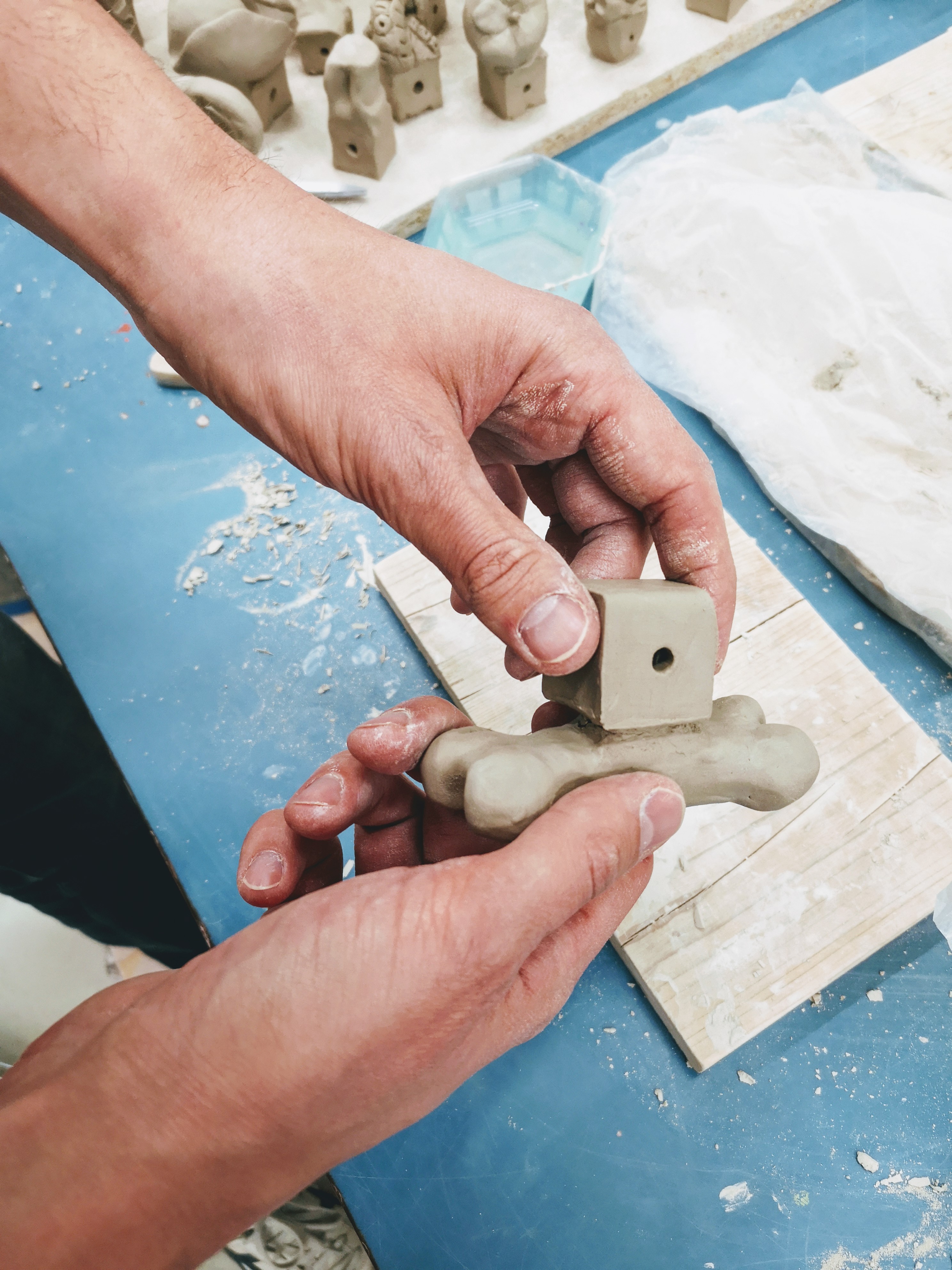
The workshop table was set up with five workstations, a hand full of tools, and about 10-15 pre cut pieces of fresh clay. Based on our prototyping session we had at ZHdK the day before we decided on specific sizes of the clay portions (ca. 150 gr./piece). We figured this size should allow for fast drying time of the sculptures (ca. 1 week), as well as a nice balance between the weight of the pieces and the strength of their mounts/connector pieces. This is important to properly mount/attach them in their future urban environment.

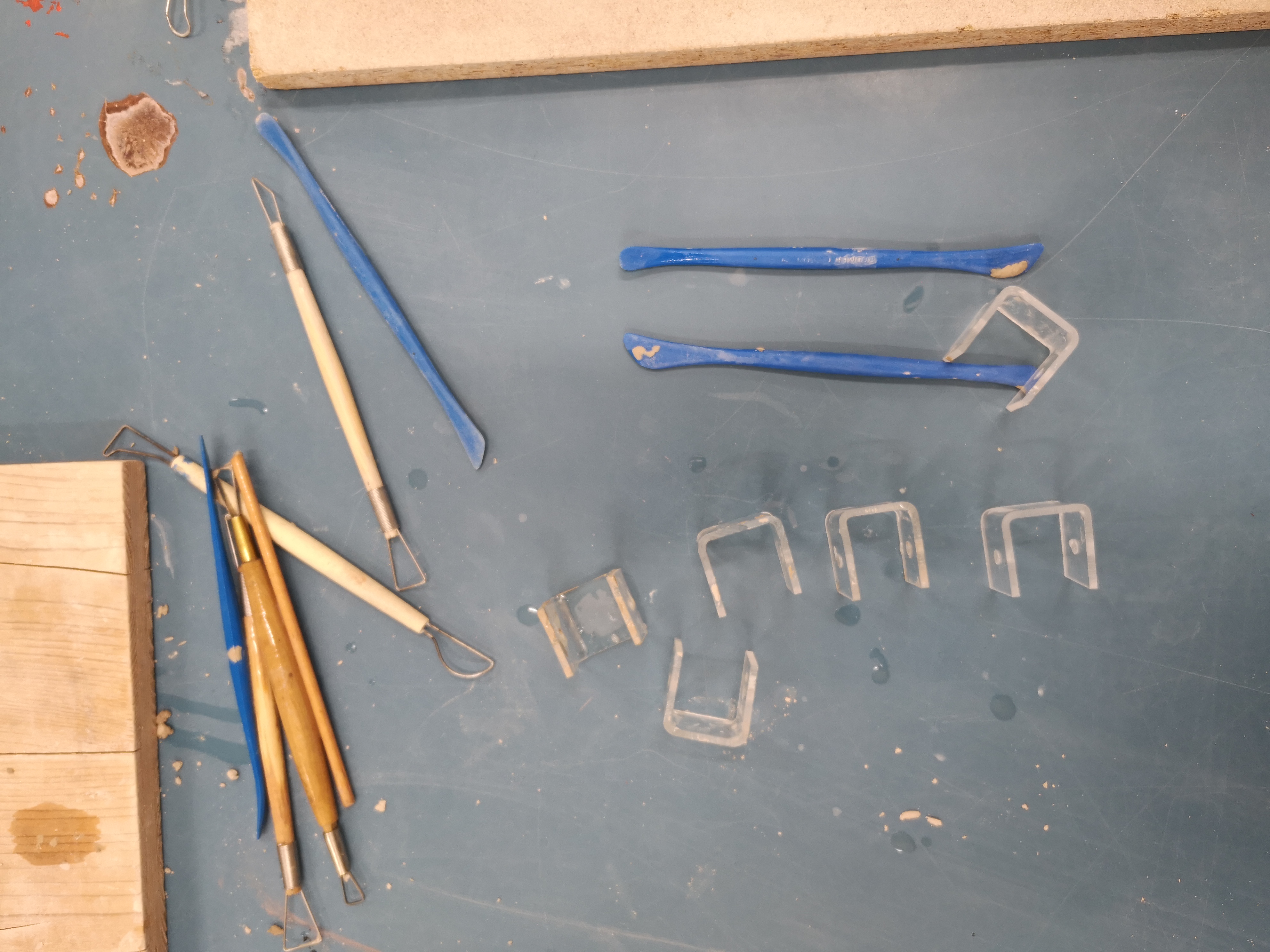
working-space with tools and molds

At this point we already had an understanding of our final goal. We were unsure however, how the patients would accept our idea. After getting positive feedback on our explanations throughout the workshop, as well from staff-members and patients, we can now consider this as our proof of concept.

We were more than pleased regarding the outcome of the workshop. In total, 21 pieces were made within 90 minutes by participants and ourselves. The molds worked well, but need to be adjusted with bigger holes, as the ones on the prototypes will shrink too much and no longer fit a zip-tie. Also we will prototype a stamp to easily label the objects with some sort of info (maybe a url or an instagram hashtag).

Unfortunately it is highly possible that within the remaining 3 weeks of our course we will not be able to produce and fire another series of prototypes and have them ready in time to be placed outdoor. If necessary we will use the ones from this workshop to play through the whole process.

Desk Research | Week 3

Stigmatization

“Measuring the impact of programs that challenge the public stigma of mental illness” (2010) — Corrigan, P.W., Shapiro, J.R.

Corrigan & Shapiro (2010) attempt to measure the outcomes of anti-stigma programs against mental illness. The first point of discussion is how research on social cognition has informed our understanding of stigma. Stigma was originally defined by Erving Goffman (Canadian-American sociologist of the twentieth century) as “a mark or attribute that reduces an individual ‘from a whole and usual person to a tainted, discounted one'” (p. 909). In other words, we consider a certain attribute or characteristic of a person to be of lesser value.

Once the reader understands stigma through a social cognitive lens, the authors then discuss the following: the methods we use to change public stigma, specifically protest, education, and contact; the design and method considerations; the five domains to assess the impact of anti-stigma programs: behaviour, penetration, psychological perspectives, knowledge, and physiological/information processes; and finally the recommendations for future measurement and research.

This paper is an excellent overview of stigma, its effects on individuals with mental illness, and how we can attempt to change public stigma. What pertains to our project from Corrigan & Shapiro’s work are the methods we can use to change public stigma, as well as how we measure the impact of such methods. Our project is not directly addressing stigma, but it might be an important aspect to consider.

“How does familiarity impact the stigma of mental illness” (2019) — Corrigan, P.W., & Nieweglowski, K.

In this paper, Corrigan & Nieweglowski discuss the relationship between familiarity and the stigmatization of mental illness. They argue for a U-shaped relationship, which means: 1) As the public gains experience with mental illness the stigma decreases, but 2) As interpersonal relationships gain experience with mental illness the stigma increases (p. 41).

Perhaps what is interesting about their argument and research is how it challenges our preconceptions of stigma, particularly where it could be more common. As stated above, stigma might not be a direct concern of our project with the patients at Ateliers Living Museum, but maybe it is something to consider if we are placing artwork/objects into other environments.

Ceramics as a medium for art therapy

“Effects of clay art therapy on adult outpatients with major depressive disorder: A randomized control trial” (2017) — Nan, J.K.M., & Ho, R.T.H.

Prototyping with Clay | Week 3

This morning we prototyped with clay in the low level Werkstatt here at ZHdK. Our goal: create a connector piece to integrate ceramic objects into pre-existing structures in an urban landscape.

Working with the clay was a great hands-on experience to better understand why creating a connector piece with this material proves quite difficult — the clay is not very precise. Furthermore, when fired in the kiln the clay shrinks in size and loses water weight. All of these variables make for a challenging prototyping experience. However, working with the clay helped us figure out how we are going to incorporate our prototype into our workshop with the patients tomorrow. We are aiming to construct this prototype/ceramic mold with plexiglas.

Integrating Objects into the Urban Landscape | Week 3

After our prototyping exercise we decided to do some work in the field! As each of us made our way back home we looked to the pre-existing architecture of the city (and Jumbo) for inspiration. We asked ourselves: How can we integrate objects into other places? Instead of creating entirely new ways of displaying or placing objects, perhaps we need to use structures already in place.

Existing Structures in the City:

Jumbo:

Prototyping Ideas | Week 3

Part I

The exercise that followed bodystorming was prototyping our ideas. For our group, we needed to consider how to prototype a ceramic form for the patients to work from. As this is a participatory design project with patients from Ateliers Living Museum Wil, we have not decided yet, whether the ceramic object will be abstract or more personalized. If the objects are abstract will they be modular? If yes, this could allow for others to contribute to the project. If no, we need to think about how to maintain some sort of unity between the ceramic objects. For us this might look like a modular way of displaying the pieces. In addition to the “ceramic form” prototypes, we also thought about a digital map to keep track of either the movement of the objects, or the collaboration of others.

Part II

The second part of the prototyping ideas session was to further develop our initial prototypes. At this point we really began to think about how to attach objects to pre-existing architecture in the city of Wil.

Bodystorming Exercise | Week 3

Today we began with a bodystorming exercise. As a refresher, we first encountered the term bodystorming while reading “Understanding contexts by being there: case studies in bodystorming” by Oulasvirta et al. (2003). Bodystorming was coined by Burns et al. (1994) and was defined as “reenacting everyday peoples’ performances and living with data in embodied ways by performance and improvisation” (p. 126).

What we need to remember about bodystorming is that while it is an excellent method for gaining first-hand experience, it occurs in a representative environment; you will always be an outsider looking in and trying to understand others. Regardless, it is important to learn to empathize with your user, as well as realize the important role participatory design plays.

As a quick reminder, we are interested in translating the feeling of the ceramics atelier to other places. Our bodystorming exercise was inspired both by the cultural probe we created for the patients of Ateliers Living Museum Wil, as well our project with them.

We created origami paper birds which we placed around the ZHdK. While bodystorming we considered the following questions:

  1. How does it feel to place an object in an unusual environment?
  2. Where do you place the object? Is it with intention?

We discovered many things, but maybe our most significant findings were the following: 1. Placing an object always has an intention/meaning behind it, and 2. Placing an object is like leaving a marker or legacy behind.

Sources

  1. Oulasvirta, A., Kurvinen, E., & Kankainen, T. 2003. “Understanding contexts by being there: case studies in bodystorming”. In Personal and Ubiquitous Computing, 7(2), 125­-134.

Related Works | Week 2

Together with the patients from the Ateliers Living Museum Wil we would like to create a project that translates the feeling of the ceramics atelier into another environment. In attempt to achieve this, we would like to focus on placing the usual in the unusual. More specifically, the placement of a familiar object into an unfamiliar place.

The following are selected works we believe relate to our concept.

“Dispatchwork” (2007) — Jan Vormann

Dispatchwork is the work of a German-born artist Jan Vormann. Initially he was inspired by people’s perception street art; people no longer noticed it, because it had become the norm. Jan decided to therefore change materials to once again engage people in public art. The idea was to “repair” damaged walls with colourful Lego bricks. He hoped not only to highlight the vulnerability and transitory nature of urban spaces, but also inspire spectators to engage in and take back public spaces. Since 2007, the project has been growing and is now quite a global success. Jan has created an interactive online map which shows where people have taken part of his project.

We find ourselves inspired by Jan’s work, because he has take something — Lego — out of its context and given it new meaning. Through his appropriation of these colourful blocks Jan has reengaged the spectator in public art, encouraging them to interact with public spaces and leave their mark. We are also looking to place the usual in the unusual. In our case however, perhaps it is not about giving new meaning to an/a object/material, but using an object to translate a feeling into a new place.

Dispatchwork project in NUART Festival, Stavanger 2018

“Confessions” (2012) — Candy Chang

In 2012, Candy Chang created a participatory installation in Las Vegas. Inspired by the Japanese Shinto shrine wall prayers, Post Secret, and Catholicism, Chang invited people to enter a private confession booth and write down a confession, which would then be hung on the gallery walls. Chang describes the project as an introspective project that “reappropriates religious rites for secular environments and examines how public spaces can cultivate self-realization and communal kinship.”

Participatory installation “Confessions” by Candy Chang in Las Vegas, 2012

What struck us with this project is how you can build a sense of community through anonymity. Despite not knowing who had written what, people were able to relate to the confessions of others; they realized that being human means we all have fears and faults. No one is perfect. Of course, whether our project remains anonymous or not is up to the patients of the Ateliers Living Museum. However, sometimes remaining anonymous can bring us together in unexpected ways.

“#Compulsive Charcoal” (2015) — Liz Atkin

In 2015, Liz Atkin began a project during her long commutes from South to North London. To help manage her compulsive skin picking disorder, Liz would normally sketch with charcoal in her sketchbook. One day in particular she ran out of paper, and in attempt to stop herself from having a panic attack she grabbed a discarded newspaper on the seat beside her and continued drawing. As the train is often littered with newspapers Liz realized she could use this opportunity to: 1. keep her skin picking at bay 2. give away quick drawings to people, and 3. advocate for mental health, specifically compulsive skin picking disorder. Liz has given away more than 16,000 charcoal drawings.

Liz Atkins #Compulsive Charcoalhttp://www.lizatkin.com/home/4525757914

While we may not be using this project to advocate for mental health, or give away clay objects to strangers in passing, perhaps we can understand Liz’s work also as a translation of place. She brings her sketching with her to distract herself from her disorder during her lengthy commute. Of course, we are not looking to carry around clay everywhere, but her work may help us understand how we and the patients may translate a feeling of place.

“Space Invaders” (1998) — Invader

Going by the pseudonym Invader, this Unidentified Free Artist (UFA) began the large scale project known as Space Invaders in Paris in 1998. He states that the purpose of the project is to liberate art from places such as museums and other similar institutions, as well as the space invader characters from their video games/tv screens. His idea was to translate pixels into tiles, which he would then incorporate into walls and buildings in cities. Though not intentional, his project has grown into a movement with many individuals being inspired by his work.

Space Invaders project by Invaders https://steemit.com/art/@animagic/mosaic-graffiti-and-space-invader

What we find relatable from Invader’s work, is how he achieved liberating “art” (to some degree), by moving it out of museums and institutions and into the streets of cities. We definitely have not defined our project as attempting to liberate art, but we are also trying to place the usual into the unusual. We are also moving something to a new place/environment.

Sources

  1. OFffdsfsfMZM Projects [NUART]. (2018). DISPATCHWORK NUART [Video file]. Retrieved from https://vimeo.com/294395475
  2. StreetArtNews. (2018, September 9). Jan Vormann aka Lego Man for Nuart 2018. Street Art News. Retrieved from https://streetartnews.net/2018/09/jan-vormann-aka-lego-man-for-nuart-2018.html
  3. Chang, C. Confessions. Retrieved from http://candychang.com/work/confessions/
  4. Chang, C. Confessions: Translating a religious rite into a secular ritual for catharsis, consolation, and intimacy. Ritual Fields. Retrieved from http://ritualfields.com/work/confessions/
  5. Atkins, Liz. #CompulsiveCharcoal: Free Art for Commuters. Liz Atkins. Retrieved from http://www.lizatkin.com/home/4525757914
  6. The Establishment. (2017, May 4). What Role Should Art Play In Presenting Mental Illness To The World. Medium. Retrieved from https://medium.com/the-establishment/what-role-should-art-play-in-presenting-mental-illness-to-the-world-bb963a1f82b
  7. Invader. (2014). About. Retrieved from https://www.space-invaders.com/about/

Introducing our Probes to the Patients | Week 2

On Thursday afternoon, two of us went to Wil to present our cultural probes to the patients. We prepared five identical probes to give away. Our goal was to motivate at least 3 people to participate in the project.

The staff helped us find patients for our collaboration. As we wanted to have a positive group dynamic within the people working in the ceramics-atelier, we decided to do the presentation right next to the working-tables instead of separating the interested patients from the others. After a few minutes, we found 6 people to tell our idea and had the rest of the atelier spectating our presentation from further away.

We introduced ourselves to the participants as design-students and also gave a broad idea of our collaboration with the Living Museum. Then we explained every component of the probe, trying to provide clarity and direction, while also leaving room for exploration and personal interpretation.

After our short presentation we went to every person who agreed to take part and handed them their probe. Two participants decided to proceed as a group since they’re living as neighbors. As we did not receive rich and immediate feedback from the group after the presentation, the individual explanations gave us the chance to strengthen the personal commitment of the patients, address their insecurities, clear any misunderstandings, and answer any remaining questions.

Presenting the probe to patients

Action Plan | Week 2

As our project idea so far depends strongly on the specific procedure and schedule of sculpting, glazing and burning clay-sculptures in Wil, we have to think far ahead and adapt our action plan:

  • Week 3:
    • Wednesday:
      • preparing the prototyping workshop (ZHdK)
      • checking out working process of sculpting/glazing/burning clay(Wil)
    • Thursday:
      • doing prototyping workshop (Wil)
      • collecting / evaluating cultural probes
      • feedback session with participants
  • Week 4:
    • sculpting / burnig final items (Wil)
  • Week 5 (production week):
    • collecting items from oven (Wil)
    • placing items in Wil / taking pictures (Wil)
    • evtl. setting up social media (Wil/ZHdK)
  • Week 6:
    • evaluation
    • documentation
    • saying goodbye