A week prior we had disseminated five sets for a cultural probe amongst patients. We now collected them and had the opportunity to sit down with some of the participants and discuss their experiences. Collected here are the responses to and our findings from the probe.
Postcard
We asked the participents to answer three questions in regards to a postcard of four Images of art pieces.


What do you think about works like this?
RED: “Fun, fantasy, nature+art inspiring for own creativity”
YELLOW: “To a part they are great communal works, they stand out or produce a smile. The white ‘h’ though, I find totally out of place, unfitting and not inspiring.”, “h=häää?!”
WHITE: “I find them very beautiful and enriching the environment. A pleasure for the eye.”
BLUE: “One makes nature one’s stage, one’s canvas. –but non-violently. It’s like a compliment of the artist. One gives the tree a dress, one ‘completes’ the old place or fills a corner again.”
GREEN: (To picture one:) “Super expressive, creative, colourful creation.”
(To picture two:) “A cold and closed work.” (To picture three:) “Pure nature.” (To picture four:) “Super interesting… full of meanings…”
What inspires you in these works?
RED: “The colours.”
YELLOW: “Joy and ease in the everyday. (As long as the works aren’t paid for by the taxpayers 🙂 ) In between it’s nice to escape normality, not everything has to have a practical sense.”
WHITE: “The picture with the tree reminds of the project I wanted to do in *Benlav* once. It inspires me to knit again. And the corner of the house with LEGO reminds me of artistic area in Vilnius, Lithuania. It inspires me to dress myself more colourful and bravely and with confidence stand out of the crowd.”
BLUE: “It’s like a game. One plays with nature and adds human silliness.”
GREEN : (To picture one:) “Mediates joy, travelling in the imaginary…”
(To picture two:) “Prison of a river, the stride of the future/goal”
(To picture three:) “What counts is today = get it (in Portugal)”
(To picture four:) “As much as life beats you down, you can always build it up stronger and more colourful.”
From where do you know these works?
RED: “The ‘h’ from the newspaper.”
YELLOW: “The ‘h’ from the town pond, about the trees I once read something in the newspaper, the wall reminds me of the LEGO houses of our childhood, don’t know where it stands. I have never seen the water feature, but I’m sure it’s in the garden of a expensive villa.”
WHITE: “I have only seen similar objects to the first picture – with the knitted around tree. Rest of the objects I have not seen before.”
BLUE: “Half of them don’t remind me of anything. The corner with LEGOs I saw on the internet and the ‘h’ recently by the ‘pond’.”
GREEN: (To picture one:) “No.” (To picture two:) “No.” (To picture three:) “***…Pond”
(To picture four:) “I know (it), but…”
NOTE: The answers of participants RED, YELLOW, BLUE and GREEN have been translated from standard German. We tried to find a balance between getting their answers across concisely, fittingly, in an understandable manner without interpreting too much of our view into them.
FIMO
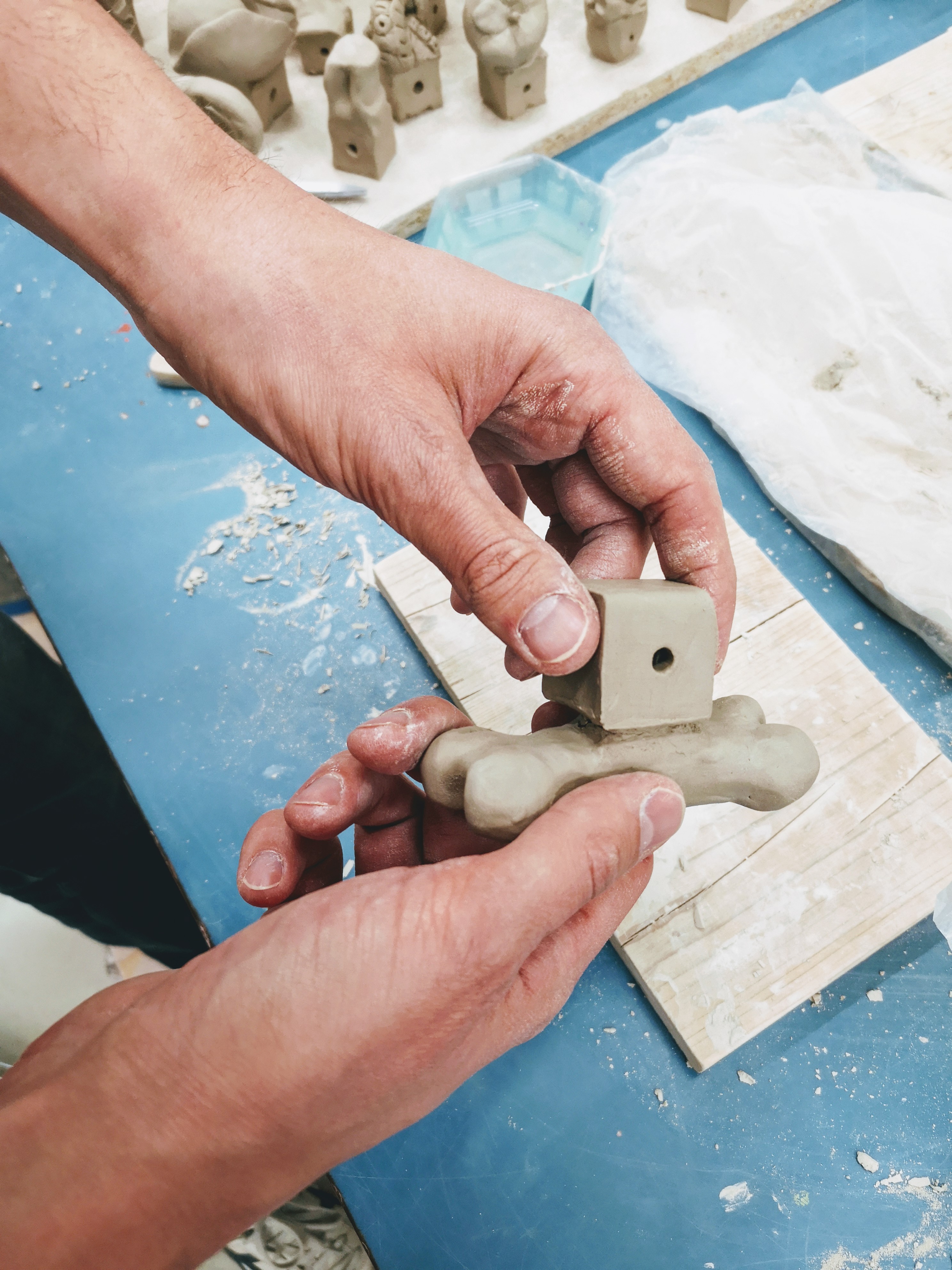
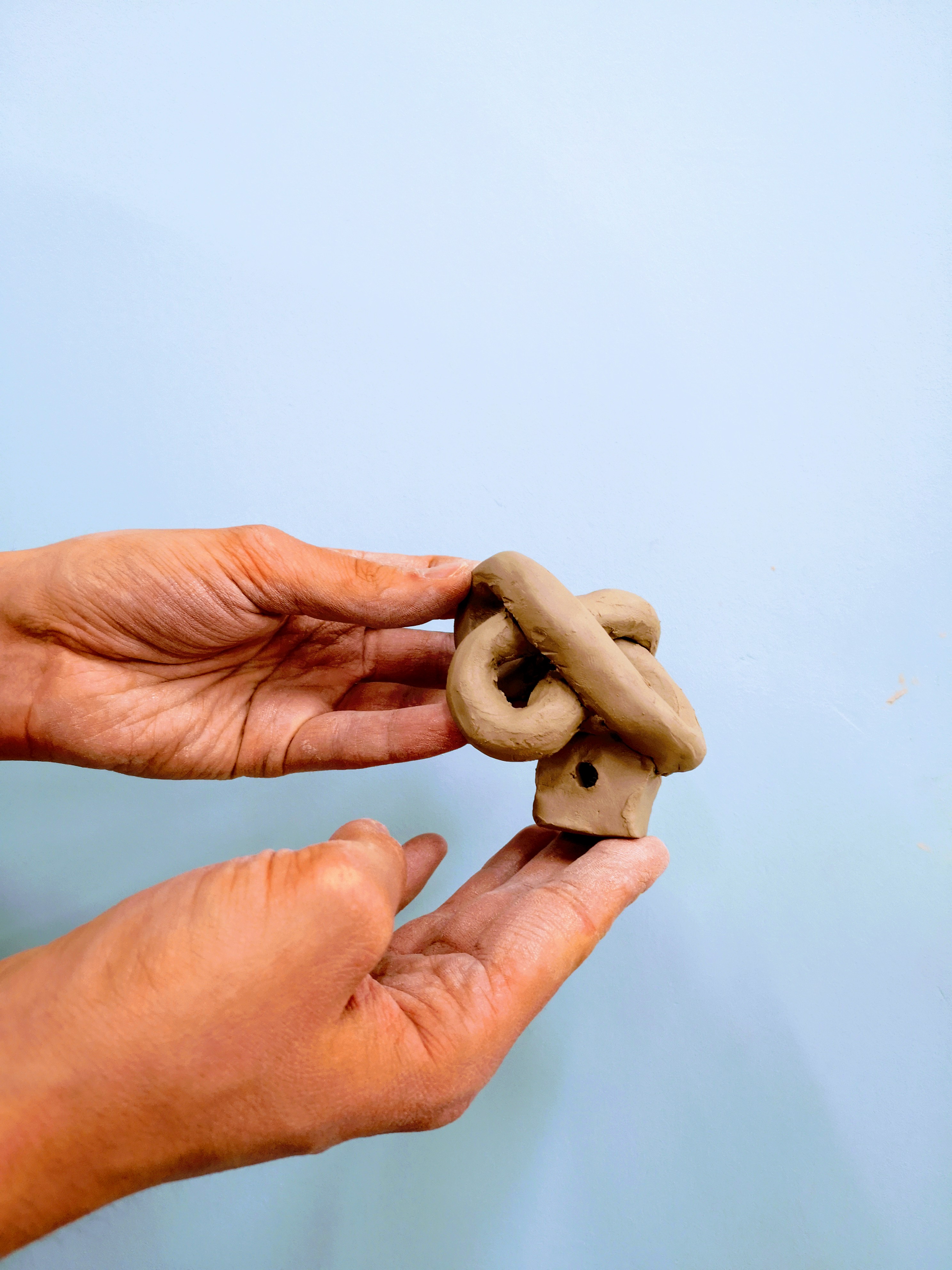
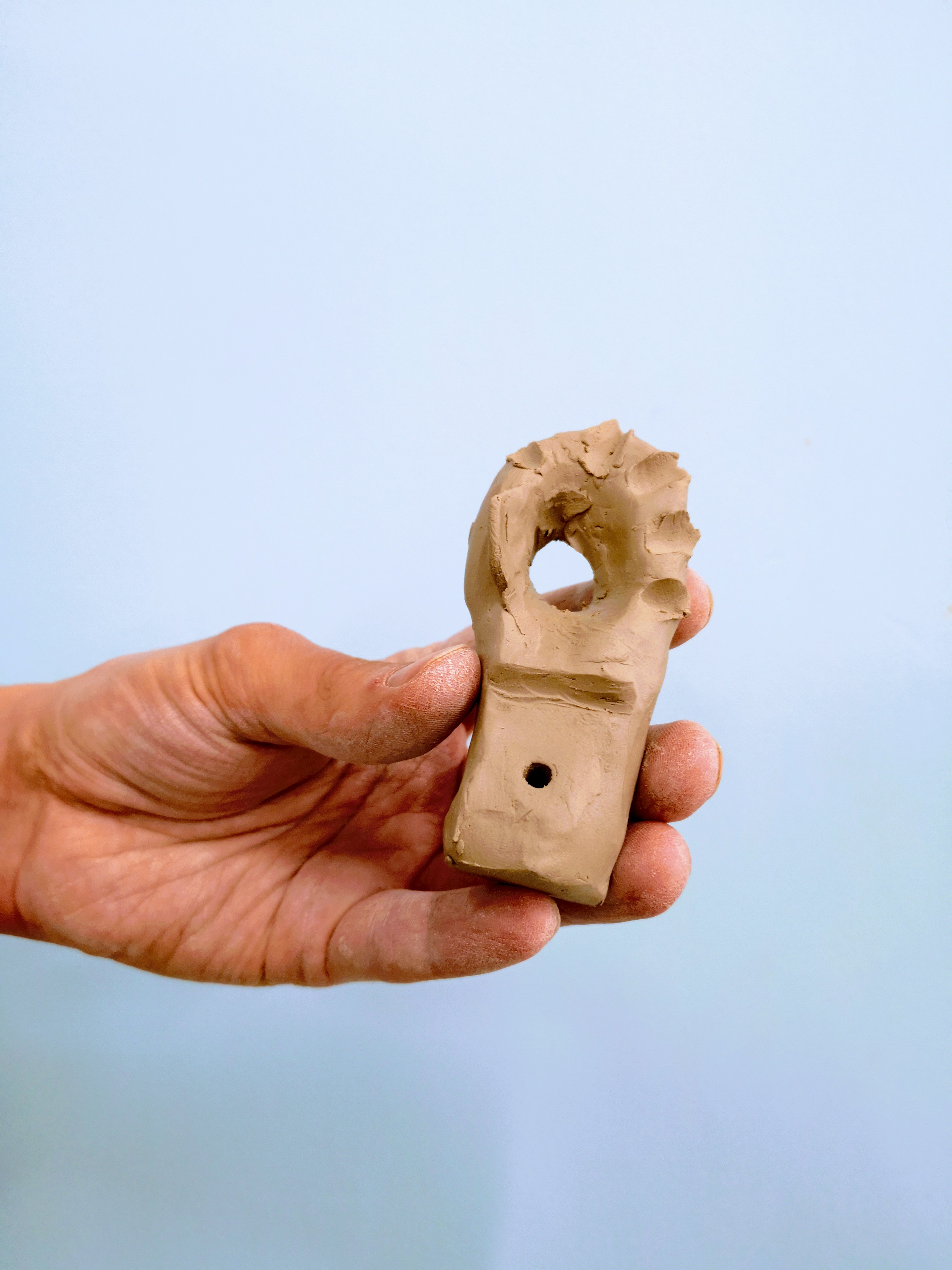
We asked the participants to create a sculpture out of FIMO clay at home.


Stone/Chicken/Egg
We asked them to place three provided objects outside the clinic and to send us photos of them in their new environment:


Map
Finally we asked them to draw their way from the studio to their home and to mark places they especially like.


Findings
In general the answers we received proved to be insightful in many ways we hadn’t expected. We were very excited to see that almost all participants completed all the tasks we asked of them and were also able to use the probes as an introduction to our following workshop. Though the probes may have originally been received with a certain amount of suspicion, the answers we received ended up being very open, and it seemed people enjoyed taking part. One participant mentioned that once they decided to approach the tasks openly they found themselves finding meaning in them, looking at the environment in a slightly different way than normal while looking for a place to take photos. Some of course still were slightly confused about our aim, but discussing the probes afterwards we could explain our intent and this seemed to clarify these cases and lead to a renewed interest in the project.
The responses to the postcard showed a definite interest in the guerilla art projects, especially towards the colourfulness and the integration into the surroundings.
One participant mentioned in the following discussion that she generally prefers combining art with a practical aspect, which could be interesting moving forwards.
The FIMO clay was generally well received, though some felt it hard to knead at first and in one case it had hardened. The participant in this case added oil to the clay, and though it ended up a sticky mess, according to the participant, the textures that resulted from this seemed quite interesting.
Notably, all the participants created sculptures based on plants or animals when left to their own devices. This topic of nature also seemed to continue in the other tasks.
From the feedback we received, placing the objects into the environment appeared to be a generally positive task. Often finding a fitting place happened spontaneously. Again scenes of nature prevail, though some showed interest in exploring more urban environments during our discussions.
The maps show a variety of ways to see one’s path home, some focused on geographical landmarks, impressions along the way, or technical details. In and of themselves, interpreting the responses is still tricky, but they opened a discussion of how the participants see their transit and their surroundings. One mentioned that due to this exercise they found new interesting places along their route.
Generally the discussions we were able to have after the probes had been completed proved to be a vital part. There were some problems regarding our system of uploading photos, this proved too complicated, for only three of five the upload worked, and showing the process to one, on a different mobile OS than we had tested it on, it proved to be excessively obtuse.





 Interaction Design Process FS19