
Introduction to Ateliers Living Museum
During our first week of the Interaction Design Process class we visited the Ateliers Living Museum Wil for the first time. We were greeted by Dr. paed. Rose Ehemann, leader and founder of the museum/atelier. She began with a brief introduction to the space, explaining how it was inspired by the philosophy of the living museum in New York. Afterwards we walked through each atelier (i.e. ceramics, art & media, paper, and glass & wood) and were introduced to various staff. At this point we began to realize our immediate impact on the surrounding environment. As the majority of the patients were concentrated on their work, it felt as if our presence was intrusive.
If we had to describe our overall impression it would be one of surprise. We were overwhelmed by the size of the facility, the choices of mediums available, the variation of work, and the freedom of the patients. Perhaps most striking however was this feeling of creativity that enveloped you once you entered the space.
Getting to Know Patients & Their Creative Process in the Ceramics Atelier | Day 1
The first day conducting field research was not about interviewing or filming patients, but gaining a sense of trust and understanding of how they work in the ceramics atelier. When we arrived at there, Stefan, head of the ceramics atelier, briefly introduced us to the patients there at the time. Immediately we were welcomed and asked to join in the ceramics process. The four of us spread out and began introducing ourselves individually to the patients at the tables we were working at. This was a wonderful way in which to meet patients. We were able to engage with them using ceramics as conversation starter. As most of us have little to no experience with modelling clay the patients shared their techniques and we were able to ask about their work.
Introducing Ourselves as Students | Day 2

Process for discovering important themes for interview questions
After building a certain level of trust with patients on the first day, we began to introduce ourselves more as design students who are working on a project together with them. Earlier that day we prepared a set of questions that would hopefully help us to better understand the patients and how they work creatively, both individually and collaboratively, as well as how they view/participate in the community at the atelier. Our questions were quite broad, but we were attempting to gain an initial understanding of this feeling provided for the patients in the ceramics atelier. It is maybe important to note here, although we were interviewing patients, our interview style was still conversational. We still focused on feeling the mood and understanding the limits of each patient. Below are the set of questions we prepared, along with the responses of some of the patients:
Where are you creative? (i.e. home, atelier)
- Everything is here in the ceramics atelier already, including a means of feedback. For this reason it is harder to find the motivation or help to be creative —Plate & Face
- I have to come to the atelier to be creative. At home I’m too distracted by other things —Pinguin
- I’m a cook myself, there I can be creative (I’m just doing pottery for the restaurant I’m currently working). I also do graffiti, but it is hard to find legal spaces for that —Tapas-Bowl
- I paint at home, but the ceramics-atelier is a nice place for me because I can do (useful) things, which I can’t do at home —Vase
- I have a small atelier at home, I work with felt and paint —B
How do you see yourself as an artist?
- Enjoys being creative, but does not define himself as an artist —Plate & Face
- Works precisely —Plate & Face
- Almost arrogant to call yourself and artist; someone must label you as that —Plate & Face
What inspires you?
- Other patient’s work (i.e. flowers), etc. —Plate & Face
- My surrounding (relatives, domestic animals) —Pinguin
- Things I see in shops… —?
How does art make you feel?
- More about the process than the final product —Plate & Face
- It’s not necessarily even about the result, It’s nice when it works out —B
What do you do with your art? (i.e. throw away, keep, etc.)
- Toss, create something useful, a gift, or just explore material —Plate & Face
- I took part in some exhibitions from the clinic —Pinguin
- I’ve sold some of my work, which makes me proud —Pinguin
- I make gifts to my friends, family etc. —Pinguin
- I’ll bring my pottery to the restaurant I’m working at the moment (for serving tapas) —Tapas-Bowl
- I take them home, slowly there’s no space left though, I make some specifically for people, family or friends —?
What do you like about ceramics as a medium?
- Able to work with hands —Plate & Face
- It is so easy to add and remove clay on the fly, which you can’t do with other materials/techniques (e.g wood) —woman1
What other forms of art do you enjoy?
- Describes himself as creative; plays the violin (enjoys classical; hopes to explore jazz, and irish) —Plate & Face
- …used to work as a poster designer,(…) screen printing —B
How do you exhibit your work?
- Feels no need to exhibit work —Plate & Face
- Not necessarily proud of work —Plate & Face
- At the exhibitions of the living museum —Pinguin
- I don’t feel good enough to exhibit ceramics. One thing I made otherwise, there’s a book coming out in England, by someone who also did a research project here, my work is on the cover —B
Do you wish to learn other things in the ceramics atelier? (i.e. oven, recycling process)
- Interested in seeing how the oven works —Plate & Face
How often are you in the ceramics atelier?
- 5x/week —Plate & Face
- 2x/week —Pinguin
- 1x/week, that’s all that was approved —B
How would you describe the community?
- Not a strong community feel, but people interact and sometimes exchange phone numbers —Plate & Face
- There are a lot people who take hard medicaments, which makes it hard to build a constant relationship, since they’re not mentally stable —Pinguin
- Just being here, I know most of the people here, some I’ve known for years —?
How do you meet people here?
- Ask each other about techniques (i.e. rose leaves) —Plate & Face
- It’s all about empathy, openness, some people don’t want to interact much, (…) one has to respect that —B
What do you do in your free time?
- Not much? —Plate & Face
- I’m going to play basketball afterwards —Tapas-Bowl
How do table arrangements work in the ceramics atelier?
- The table arrangements are more about who people want to work with/beside —Plate & Face
How do you feel about group work/projects?
- Group work can be difficult, as many people are coming and going quite often. However, many different techniques coming together could be nice —Plate & Face
What do you think about creating ceramics for the ateliers-living museum? (i.e. ash trays)
- Nice possibility, but not mandatory —Plate & Face
- I think those are more likely things that people didn’t want to take home —B
Can you describe the importance of the ateliers-living museum for you?
- “I would stay longer if I could” —Plate & Face
- Very important. It gives me stability in my life since about 10 years —Pinguin
Knowledge Gained
Not every technique for conducting interviews is suitable. It might be the case in our situation that recording is better, because the interview may become more of a conversation that flows naturally. In addition, you would be recording the interview word for word, instead of taking notes and potentially misinterpreting in the moment what the patient means. Lastly, taking notes may distract and/or affect the behaviour of the person being interviewed.
Shifting Focus
Our original question was “how do rituals provide stability?” More specifically, we wanted to explore how rituals could potentially ease the transition between the Ateliers Living Museum and the home. However, after spending two days in the field we began to understand that the entire process of working in the ceramics atelier is a ritual in and of itself; it’s not a collection of rituals you can separate and look at individually. In this sense the ceramics atelier provides more of a feeling to the patients. As a result we became interested in how to bring this feeling of the ceramics atelier to the home, or using it as a means of transition between the home and the ceramics atelier.
Imagined Scenarios
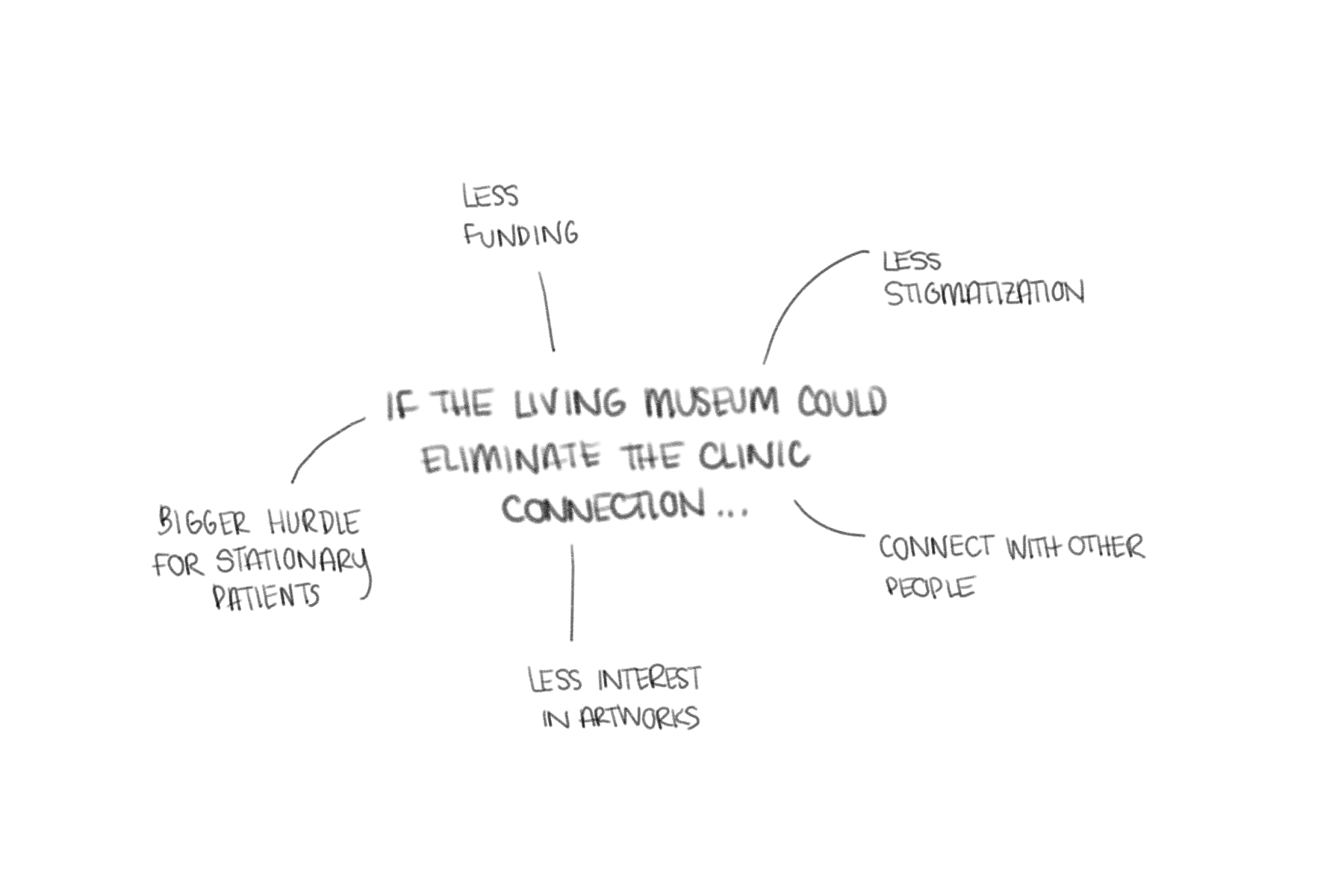
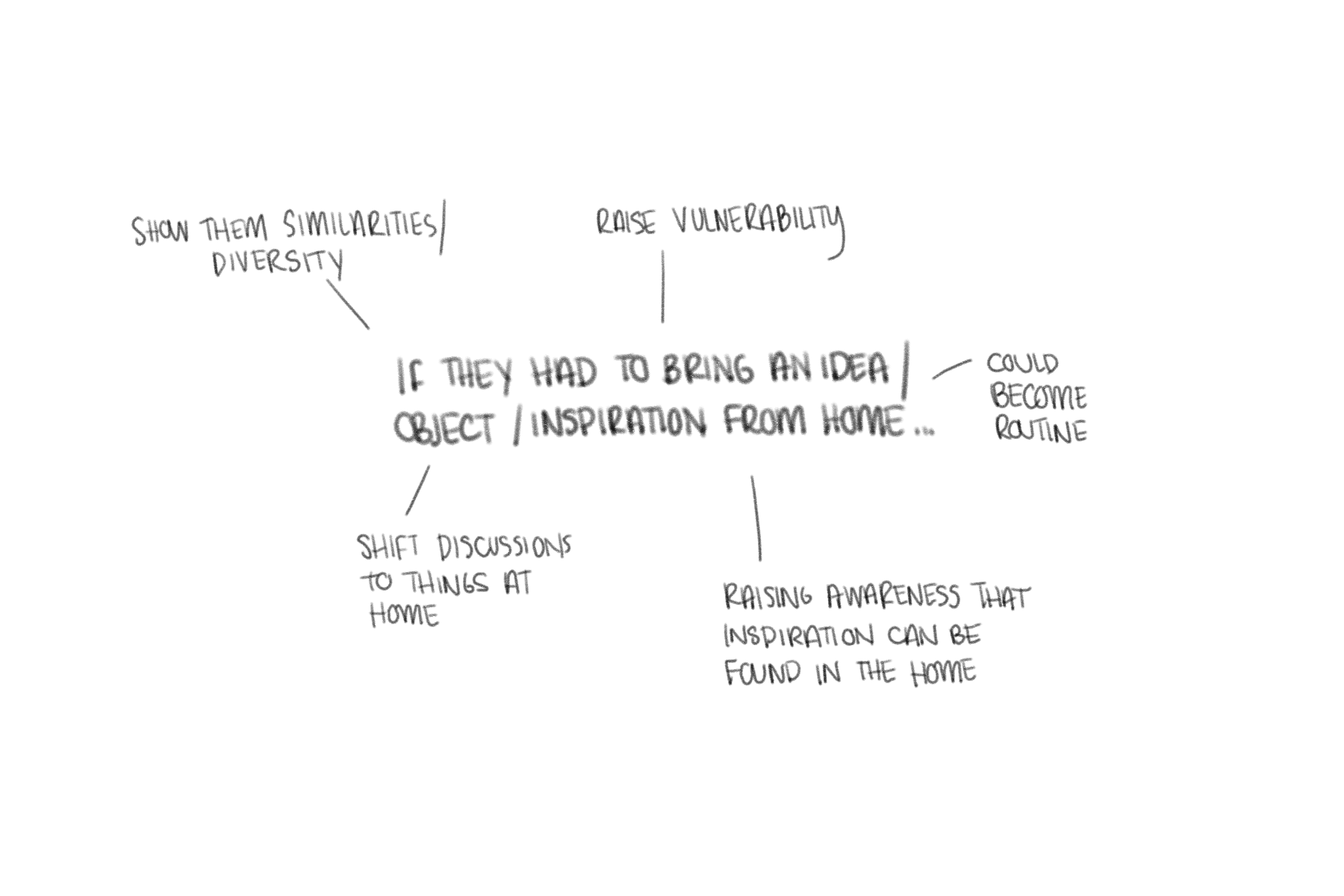
One of the ethnographic techniques we were introduced to by Nicole was this idea of “what if…” statements. The idea behind this method is to simply ask “what if…” and consider the consequences, whether they are positive, neutral, or negative, of carrying out this concept or project. The “what if…” questions; if we were to carry out a project what would the consequences be, both positive and negative




 Interaction Design Process FS19